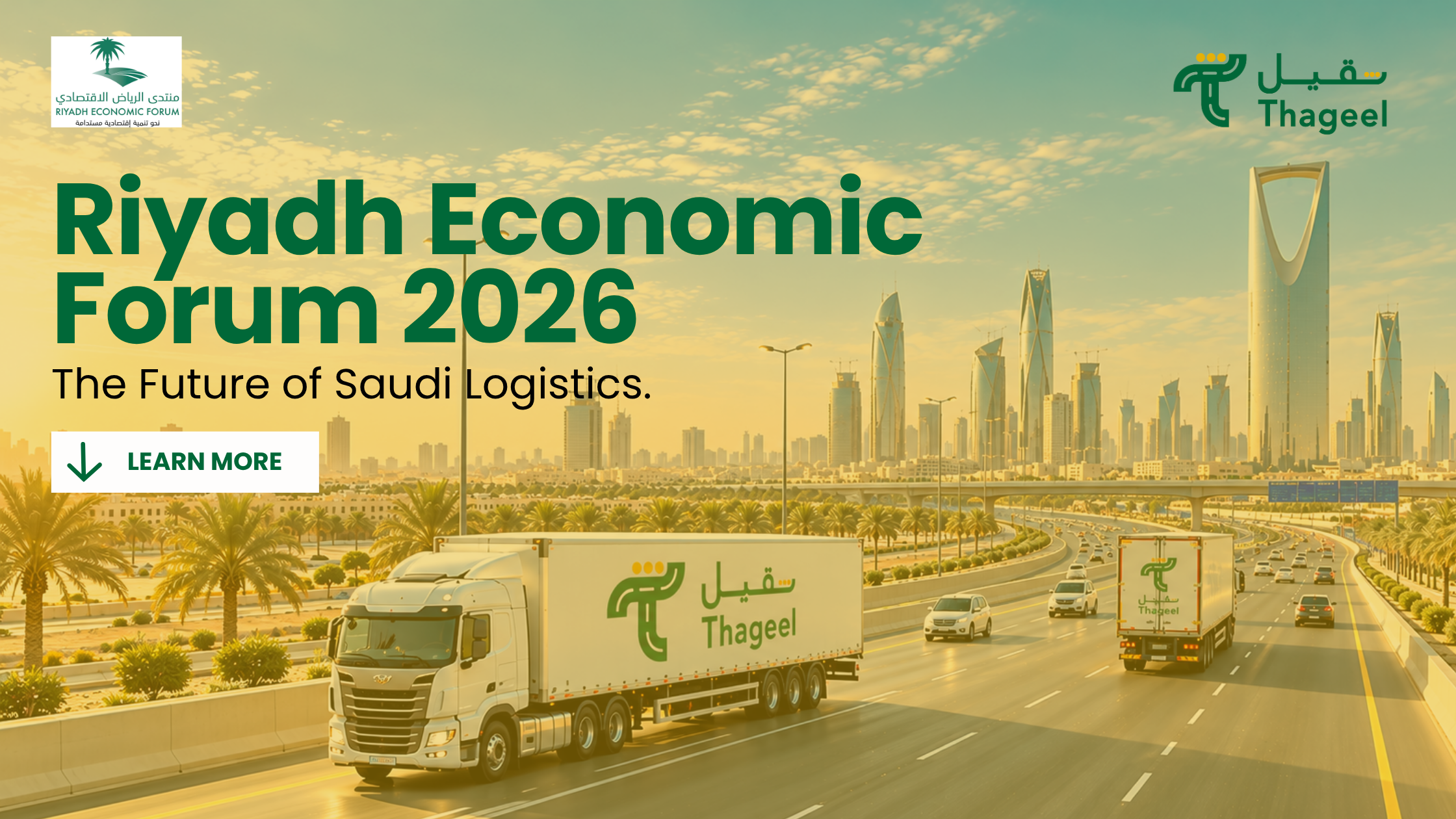
Saudi Arabia’s economic development is increasingly shaped by collaboration between government institutions, businesses and specialized economic experts. Against this backdrop, the upcoming 12th Riyadh Economic Forum is set to bring together officials, decision-makers and economic experts in Riyadh from October 12 to 14, 2026.
According to the Saudi Press Agency (SPA), the forum builds on 11 previous editions that produced 57 scientific studies and 384 recommendations and initiatives, several of which contributed to important development and economic decisions in the Kingdom.
While the forum is broader than transportation or logistics alone, its emphasis on economic efficiency, competitiveness and public-private-sector cooperation is relevant to companies operating across Saudi Arabia — including manufacturers, distributors, retailers, contractors and businesses that depend on dependable freight transportation.
For companies managing the movement of goods, the wider economic environment matters. As Saudi Arabia continues developing its logistics infrastructure and supply chains, businesses increasingly need transportation operations that are structured, coordinated and aligned with changing market requirements.
What Is the Riyadh Economic Forum 2026?
The Riyadh Economic Forum is a platform focused on economic dialogue and practical development in the Kingdom.
The 12th edition will take place in Riyadh from October 12 to 14, 2026, bringing together government officials, decision-makers and economic specialists.
The forum’s stated objectives include strengthening cooperation between the public and private sectors, facilitating direct discussions between the business community and policymakers, and helping translate research and recommendations into tangible outcomes.
Its history is also significant. Across its previous 11 editions, the forum has produced 57 scientific studies and 384 recommendations and initiatives. SPA reports that these outputs have contributed to important development and economic decisions in Saudi Arabia.
This gives the 2026 edition a broader context than a conventional business conference. It represents an established channel for discussing economic priorities and connecting research, policy and business perspectives.
Why Economic Efficiency Matters to Saudi Businesses
Economic efficiency is not only a government-level concept.
For businesses, it can influence how efficiently goods move, how supply chains are organized, how infrastructure is used and how companies coordinate with service providers.
A manufacturer, for example, may depend on multiple transportation movements between suppliers, warehouses, production facilities and customers. A retailer may need reliable movement of inventory between distribution points and stores. A construction company may coordinate the transportation of materials and equipment across multiple project locations.
In each case, transportation is connected to the wider business environment.
When infrastructure, regulations, technology and private-sector participation develop together, businesses have the potential to organize their operations more effectively.
This is particularly relevant in Saudi Arabia because the Kingdom is continuing to build its position as a major logistics and trade hub under Vision 2030.
Saudi Logistics Is Part of a Larger National Development Strategy
Logistics has become an important component of Saudi Arabia’s economic transformation.
Saudi Vision 2030 identifies the ambition of positioning the Kingdom as a global logistics hub while improving the performance of logistics hubs and strengthening local, regional and international connectivity.
The Kingdom’s 2025 Vision 2030 annual report describes continued development across the logistics ecosystem, including logistics zones, smart-port initiatives and 59 logistics hubs across the Kingdom. These developments are relevant to businesses far beyond the logistics industry itself.
Manufacturing, retail, construction, food distribution, industrial supply and e-commerce all depend on the ability to move goods between locations. As economic activity expands across different regions, transportation networks and logistics services become an increasingly important part of business planning.
What Does the Forum Mean for the Logistics Sector?
It is important to distinguish between what SPA has actually announced and the broader implications for logistics.
The SPA announcement does not state that the 12th Riyadh Economic Forum is launching a specific new freight program, changing transportation regulations or introducing a particular logistics initiative. Instead, its relevance to logistics comes from the forum’s wider focus on economic efficiency, competitiveness, business-government dialogue and practical implementation.
Those priorities intersect naturally with logistics.
A more competitive business environment requires companies to manage transportation efficiently. A growing industrial base requires dependable movement of raw materials and finished goods. Expanding commercial activity creates additional demand for organized freight operations.
In this sense, developments in the wider Saudi economy can increase the importance of structured logistics without implying that the forum itself has announced a new logistics policy.
Public-Private Collaboration and Saudi Logistics
One of the most notable themes in the SPA announcement is the forum’s emphasis on public-private-sector partnership.
This matters because logistics depends on multiple stakeholders.
Government authorities establish regulations and standards. Infrastructure operators provide transport networks and facilities. Carriers operate vehicles and move goods. Shippers plan transportation requirements. Technology platforms can help businesses organize interactions between different participants.
The Transport General Authority plays a regulatory and supervisory role across Saudi Arabia’s land, sea and rail transport sectors, including licensing transportation activities and monitoring service quality and safety. For freight businesses, this regulatory environment makes structured processes particularly important. Companies arranging transportation need to understand the relevant requirements, work with appropriate transportation providers and maintain clear operational coordination.
Digitalization can support this shift by making logistics processes more organized and easier for businesses to manage.
What Saudi Businesses Should Watch
Businesses do not need to interpret the Riyadh Economic Forum as a direct change to freight regulations. Instead, companies can view the forum as part of a broader conversation about how Saudi Arabia can improve economic efficiency and competitiveness.
For businesses that regularly move goods, several areas deserve attention.
1. Transportation efficiency
Freight is an operational cost as well as a supply-chain requirement. Companies can benefit from reviewing how they plan routes, arrange carriers and coordinate transportation requirements.
2. Supplier and carrier coordination
As supply chains become more complex, businesses may work with multiple carriers and transportation providers. Clear communication and structured coordination can reduce unnecessary operational friction.
3. Digital logistics
Saudi Arabia’s broader economic transformation includes digitalization across many sectors. Logistics businesses and shippers are increasingly operating in an environment where digital tools can help organize transportation processes.
4. Supply-chain resilience
Businesses operating across Riyadh, Jeddah, Dammam, Makkah, Madinah, and other Saudi regions may need transportation planning that accounts for different routes, facilities, suppliers, and delivery requirements.
5. Regulatory awareness
Land freight operates within a regulated environment. Businesses should ensure that their transportation arrangements comply with applicable Saudi requirements and that transportation providers have the appropriate authorizations for their activities.
What This Could Mean for Land Freight in Saudi Arabia
The future of land freight in Saudi Arabia is closely connected to the Kingdom’s broader economic development.
As industrial, commercial, and infrastructure activity grows, the movement of goods becomes increasingly important to business operations.
That does not necessarily mean businesses need more transportation options alone. They also need better ways to organize transportation. For procurement and supply-chain teams, this can mean having a clearer process for identifying suitable carriers, communicating shipment requirements, coordinating transportation, and planning freight movements.
For carriers, structured access to business demand can create a more organized operating environment. The broader objective is not simply to move more goods. It is to create transportation processes that support efficient business operations.
The Growing Role of Digital Logistics in Saudi Arabia
Technology is becoming an increasingly important part of the Kingdom’s logistics ecosystem. Saudi national strategies have emphasized improving logistics efficiency, connectivity, and the participation of the private sector. Digital systems can contribute to this development by helping businesses organize information and interactions involved in transportation.
For shippers, digital logistics can make the process of arranging freight more structured. Instead of treating each transportation requirement as an isolated task, businesses can approach freight as an operational workflow involving requirements, carrier selection, coordination and execution.
This shift is particularly relevant for companies handling frequent road freight movements.
How Thageel Connects With This Direction
The wider development of Saudi Arabia’s economy creates a growing need for structured freight operations.
Businesses need to coordinate with suitable carriers, organize transportation requirements and plan land freight in a way that fits their operational needs.
This is where Thageel fits into the conversation. Thageel is a Saudi land-freight and logistics technology platform that connects businesses with verified/licensed carriers and helps make freight booking and transportation coordination more structured.
Its positioning — Smarter Structured Logistics — reflects a simple principle: freight transportation should be organized around clear business requirements and better coordination between shippers and carriers. For Saudi businesses that regularly move goods by road, a structured approach can help make transportation planning a more integrated part of their supply-chain operations.
Looking Ahead
The 12th Riyadh Economic Forum comes at a time when Saudi Arabia continues to develop its economy, infrastructure and logistics ecosystem. The forum itself should not be interpreted as announcing a new land-freight policy. Its importance lies in its established role as a platform for economic dialogue, research, public-private engagement and translating recommendations into practical outcomes.
For Saudi businesses, the broader message is relevant: economic competitiveness depends not only on investment and infrastructure, but also on how efficiently companies organize the activities that support their operations.
Transportation is one of those activities.
As supply chains become more interconnected and business activity expands across the Kingdom, structured freight coordination and digital logistics solutions can become increasingly relevant to companies seeking more efficient ways to manage road transportation.
Looking for a more structured way to manage your land freight in Saudi Arabia?
Explore Thageel and discover a smarter way to connect your business with freight transportation solutions.